June 28, 2026 · Updated September 13, 2026
What Is an ICT Trading Journal? Definition + How to Track SMC Setups
Most trading journals were built for discretionary or indicator-based traders. If you trade ICT or SMC concepts, you've probably noticed the problem: the standard fields don't match what you actually trade. There's no field for order blocks. No session bias column. No way to tag a liquidity sweep.
This guide explains what an ICT trading journal is, what to track, and how Wick Journal handles it.
What Is an ICT Trading Journal?
An ICT trading journal is a performance tracking system built around the concepts taught in Inner Circle Trader (ICT) methodology and its derivatives, including Smart Money Concepts (SMC). Instead of just logging entry and exit prices, an ICT journal tracks the why behind each trade,g the market structure, the draw on liquidity, the confluences that justified the entry.
At minimum, an ICT-specific journal should capture:
- Session (London, New York, Asian, or overlap)
- Bias (bullish, bearish, or neutral going into the session)
- Setup type (OTE, BMS, FVG fill, OB retest, liquidity sweep, etc.)
- Higher timeframe context (HTF trend, key levels)
- Entry model (the specific pattern used to enter)
- Result (win/loss, R:R achieved vs planned)
Without these fields, your stats become useless for ICT traders. Knowing you won 60% of your trades means nothing if you don't know which setups produced that 60%.
Why Generic Journals Don't Work for ICT Traders
A spreadsheet with columns for "entry price" and "exit price" tells you what happened. It doesn't tell you why it happened or whether your read of the market was correct.
Consider two scenarios:
- You take a long on a bullish order block during London, hit your target: +2R
- You take a long because the market "looked bullish," get lucky: +2R
Both look identical in a generic journal. But only the first trade represents a real edge you can replicate.
ICT traders need to track confluences, the combination of factors that made the trade valid. The more specifically you can tag setups, the faster you identify where your real edge is.
What to Log in an ICT Trading Journal
1. Session Bias
Before the session opens, log your bias: bullish, bearish, or neutral. After the session, mark whether your bias was correct. Over time, this reveals whether your pre-session read is actually useful or noise.
2. Setup Tag
Use a consistent vocabulary for your setups. Examples:
OB-Retest: Order block retest entryFVG-Fill: Fair value gap fillBMS-Long: Break of market structure, longLQ-Sweep: Liquidity sweep before entry
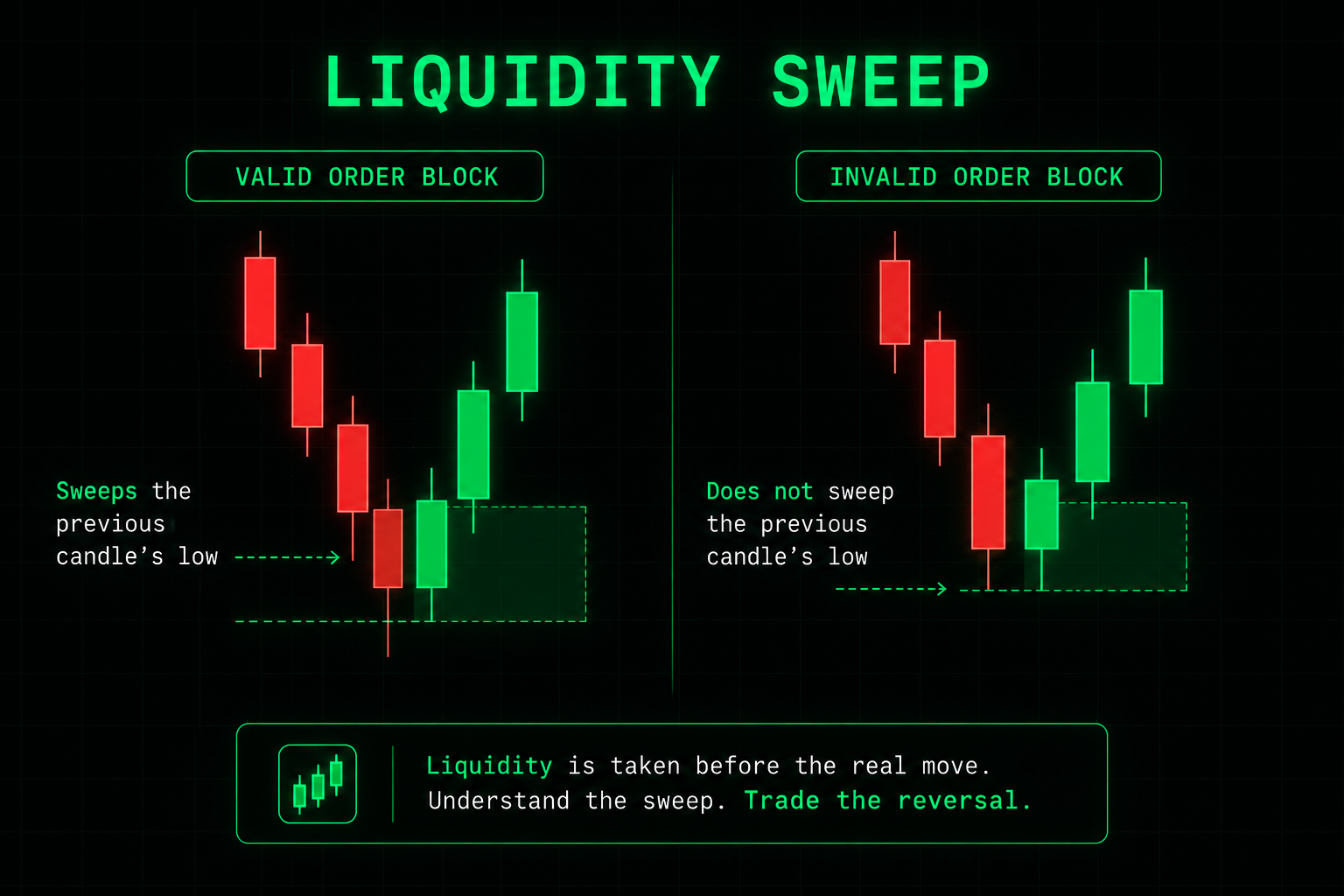
OTE: Optimal trade entry (Fibonacci retracement zone)
3. Timeframe Confluence
Log the timeframes you used for analysis and entry. A 15-minute entry aligned with 4-hour market structure and a 4-hour draw on liquidity is fundamentally different from a 15-minute entry with no higher timeframe context.
4. Draw on Liquidity
Where was price drawn to? Logging the target, an old high, a low, an unfilled fair value gap, or another liquidity pool, tells you whether your trade was aligned with the expected path of price.
5. R:R Planned vs Achieved
Log both the planned R:R at entry and the actual result. A consistent gap between planned and achieved R:R reveals execution problems (cutting winners early, moving stops, etc.).
Wick Journal lets you add custom setup tags to every trade. You can create your own tag vocabulary matching exactly how you trade. Whether that's ICT, SMC, or your own hybrid system.
The screenshot scanner extracts the pair, direction, entry, stop, and target automatically. You add the session, bias, and setup tag. In under 30 seconds, the trade is logged with full context.
Over time, the dashboard breaks down your stats by session and tag, so you can see, for example, that your London FVG fills have a 71% win rate while your New York OB retests are at 44%. That's the kind of data that changes how you trade.
The Key Metric ICT Traders Should Track: Expectancy
Win rate alone is misleading. A trader with a 40% win rate and 1:3 average R:R has a positive expectancy. A trader with a 70% win rate and 1:0.5 average R:R is slowly losing money.
Expectancy = (Win Rate × Average Win R) - (Loss Rate × Average Loss R)
Example: 45% win rate, average win of 2R, average loss of 1R Expectancy = (0.45 × 2) - (0.55 × 1) = 0.90 - 0.55 = +0.35R per trade
That's a positive edge. Every trade you take, you expect to make 0.35R on average. Wick Journal calculates this for you, and breaks it down by setup and session so you know exactly where your edge lives.
Summary
An ICT trading journal tracks the confluences, session context, and market structure behind each trade, not just the entry and exit price. The goal is to separate trades that came from a real edge from trades that were guesses.
If you're trading ICT or SMC concepts and using a generic journal, you're leaving your most valuable performance data on the table. The setups that pay you aren't random. The data will show you exactly which ones they are.
Related posts
How to Log Trades From a Screenshot (Step by Step)
The data is already on your chart. How to take a screenshot that logs cleanly, check what gets extracted, and…

How to Journal Trades Without Connecting Your Broker
Broker sync does not cover every platform, and manual entry gets abandoned. The third approach, what it…

Why Traders Stop Journaling After Two Weeks
The dropout is not a discipline problem. It is a structural one, and the data explains exactly why the habit…