August 1, 2026 · Updated September 13, 2026
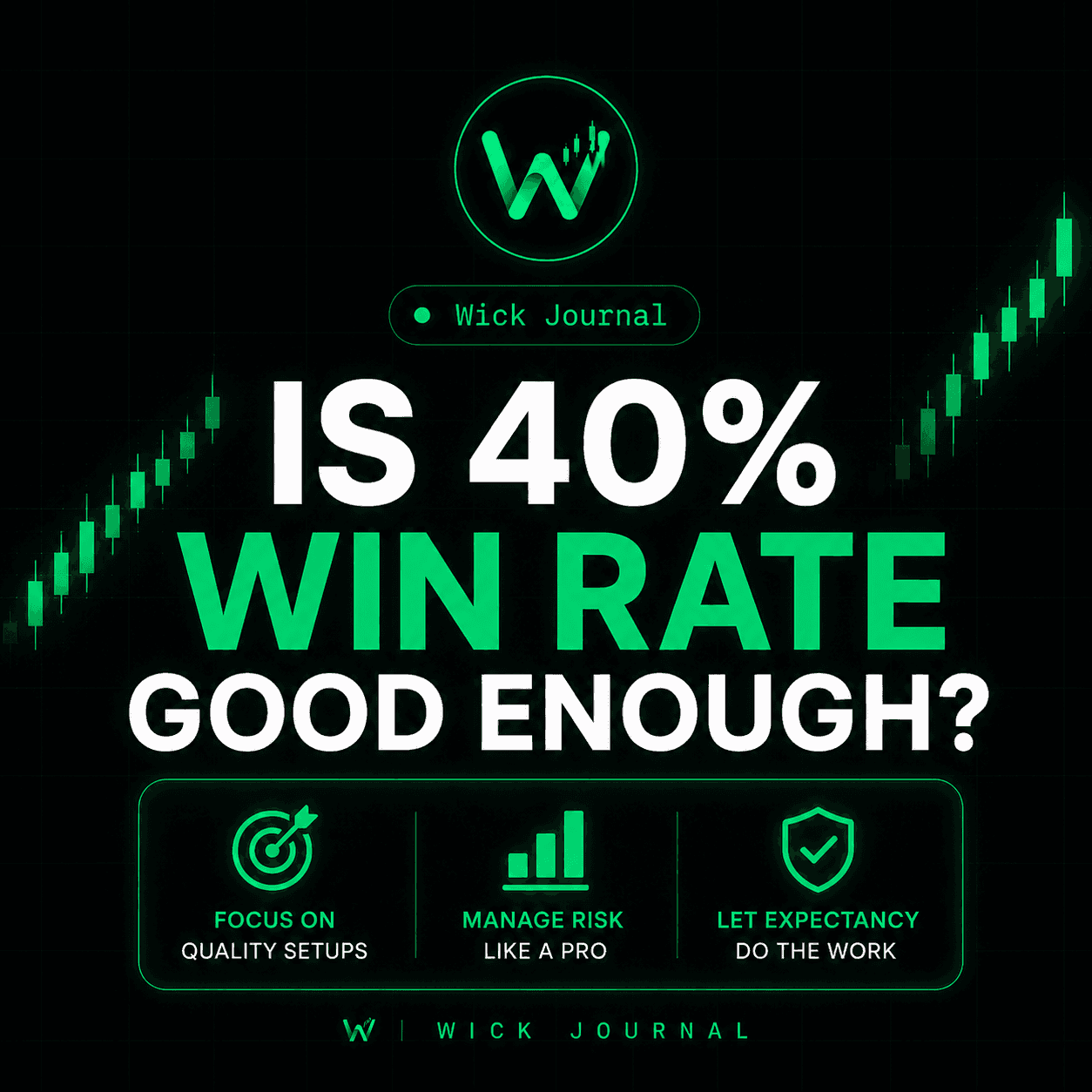
Is a 40% Win Rate Good in Trading? (Real Example Inside)
Short answer: a 40% win rate can be excellent, average, or terrible. It depends entirely on one other number, your risk-to-reward ratio. This post shows you the exact math, including a real example from our own trading.
The Only Question That Matters
Asking "is 40% a good win rate" is like asking "is 500 euros a good salary" without saying whether it's per day or per month. The win rate means nothing until you pair it with how much you make when you win versus how much you lose when you lose.
The formula that connects them is simple:
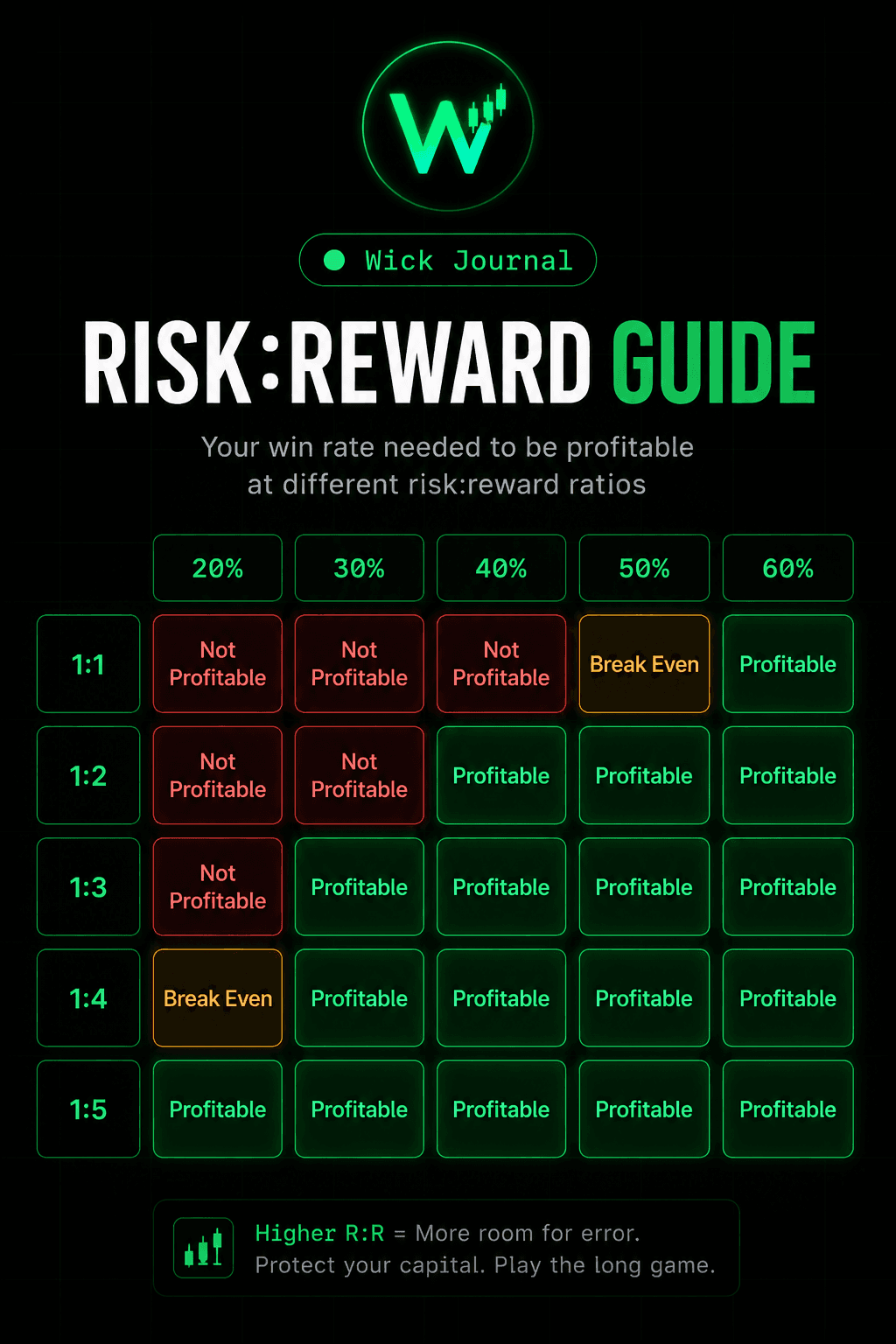
Minimum win rate to break even = 1 / (1 + R:R)
Run the numbers and the picture changes completely depending on your R:R. At 1:1, you need to win more than 50% of your trades to make money, so a 40% win rate is losing. At 1:1.5, breakeven sits at 40% exactly, so you're treading water. At 1:2, breakeven drops to 33.3%, and a 40% win rate is already profitable. At 1:3 it's 25%, and at 1:4 you only need to win 20% of the time.
So the honest answer: a 40% win rate is bad at 1:1, breakeven at 1:1.5, and genuinely good at 1:2 or better.
A Real Example: 35% Win Rate, Comfortably Profitable
This isn't theoretical for us. The system we trade at Wick Journal (CRT-based setups on EUR/USD) runs at roughly a 35% win rate with an average R:R around 1:4.
At 1:4, the breakeven win rate is 20%. Trading at 35% means the system operates 15 percentage points above its breakeven line. Run the expectancy on 100 trades:
- 35 wins × 4R = +140R
- 65 losses × 1R = -65R
- Net: +75R over 100 trades, or +0.75R expected per trade
Most traders would look at a 35% win rate and assume the strategy is broken. Two out of every three trades lose. Emotionally, it feels like losing. Mathematically, it's a strong edge.
That gap between how it feels and what the math says is exactly why so many traders abandon profitable systems. If you want the full breakdown of that psychology, read why win rate doesn't matter as much as you think.
The Part Nobody Warns You About: Losing Streaks
Here's the cost of trading a low win rate system, and it's real: losing streaks are long and frequent.
At a 35% win rate, the probability of any single trade losing is 65%. String trades together and streaks of 5, 6, even 8 consecutive losses are not bad luck. They are a statistical certainty over a large enough sample. We've had them. Every low win rate trader has.
This is where most people break. Not because the system stopped working, but because they weren't prepared for what "working" looks like. If you're in one of those stretches right now, how many losing trades in a row is normal covers the actual probabilities.
The practical rule: if your win rate is below 40%, your position sizing must assume streaks of 7+ losses will happen. If losing 7 trades in a row would blow your account or your prop firm drawdown limit, your risk per trade is too high for your win rate. Full stop.
How to Know If YOUR 40% Is Good
Three steps, all of them from your own journal data, not from theory:
Step 1: Calculate your achieved R:R, not your planned one. Take your average winning trade in R and your average losing trade in R from your last 30+ closed trades. If you plan 1:3 but exit winners early at 1:1.5, your real number is 1:1.5. Judge the system on what happened, not on what the plan said.
Step 2: Find your breakeven line. Apply the formula: 1 / (1 + your achieved R:R). That percentage is your floor.
Step 3: Compare. If your actual win rate sits clearly above that floor with at least 30 trades of data, your system works. If it sits below, no psychology trick will save it. The math has to work first. The full walkthrough with formulas is in how to calculate win rate, R:R and expectancy.
What Changes When You Accept This
Once you internalize that win rate is only half a number, your review process changes. You stop celebrating high win rate weeks that hide poor R:R. You stop panicking over losing streaks that are statistically normal for your system. And you start protecting the thing that actually makes low win rate systems work: letting winners reach their target.
That last one is where journals earn their keep. Wick Journal tracks your win rate and achieved R:R per setup automatically, so you can see in one screen whether you're above or below your breakeven line, and whether your winners are actually reaching the R multiple your plan calls for.
Frequently Asked Questions
Is a 40% win rate good for day trading?
Yes, if your average R:R is 1:2 or better. At 1:2 your breakeven is 33.3%, so 40% is profitable. At 1:1, which is common for scalpers, 40% loses money.
What win rate do professional traders have?
It varies more than social media suggests. Trend-following and setup-based traders often run 30-45% win rates with large R:R. Mean-reversion and high-frequency styles can run 60%+ with small R:R. Neither is superior. What matters is the expectancy each combination produces.
Can you pass a prop firm challenge with a 40% win rate?
Yes, but position sizing matters more than usual. Low win rate means long losing streaks, and prop firms have daily and maximum drawdown limits. Your risk per trade has to survive a realistic worst-case streak without breaching those limits.
Is a 35% win rate too low?
Not if the R:R supports it. At 1:3, breakeven is 25%, so 35% is solidly profitable. At 1:4, breakeven drops to 20% and a 35% win rate produces a strong positive expectancy. Below 30%, the streaks become psychologically brutal even when the math works.
Related posts
How Many Trades Does It Take to Pass a Prop Firm Challenge?
Most challenges no longer have a deadline, which changes the question. The math behind whether your system…
Why Win Rate Doesn't Matter as Much as You Think
A high win rate can still lose money. See why risk-reward and expectancy decide if a strategy works, not how…
How to Calculate Win Rate, R:R and Expectancy in Trading
Win rate alone can't tell you if you're profitable. Learn how to calculate win rate, risk/reward ratio, and…